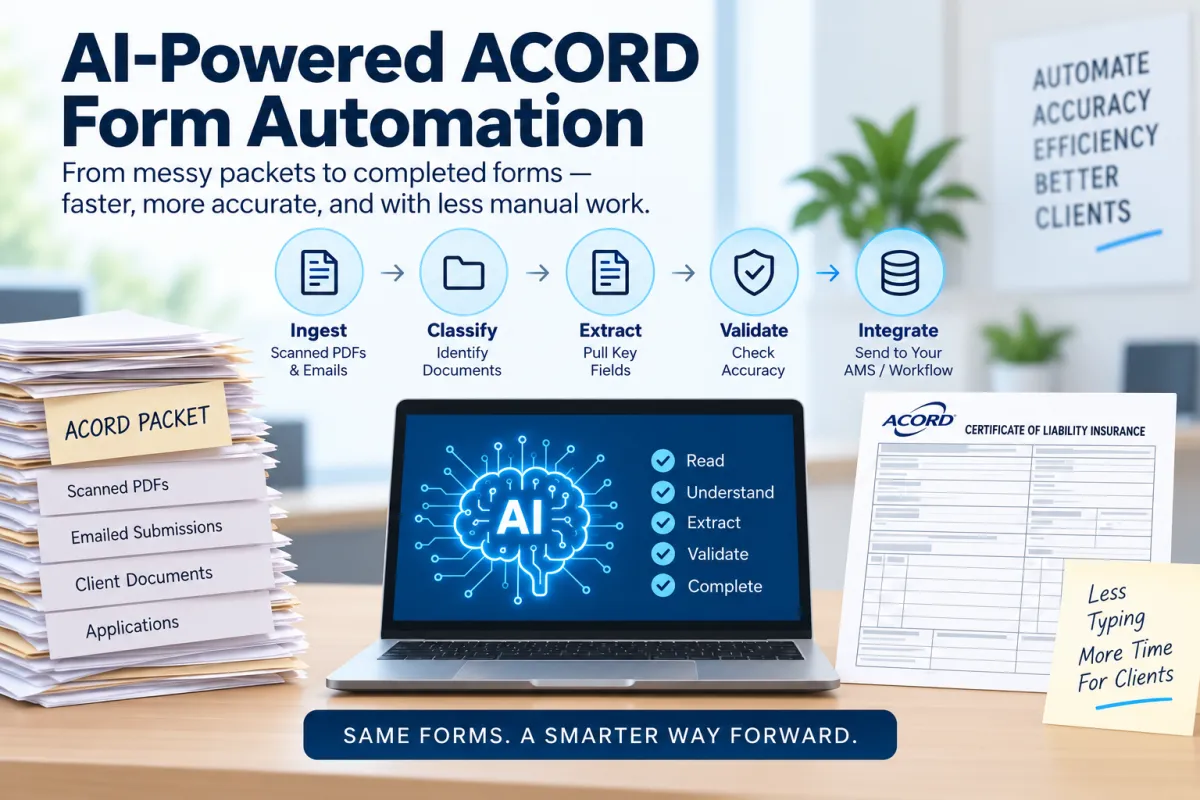
AI-Powered ACORD Form Automation: How It Works
What Is AI-Powered ACORD Form Automation?
AI-powered ACORD form automation enhances efficiency by automating data extraction, reducing manual entry, and improving accuracy in workflows, ultimately saving time and minimizing errors for insurance agents. AI in insurance typically begins with unstructured ACORD packets rather than blank forms, which can create a challenging workload while managing client interactions. You already know the packet. It arrives as a scanned PDF. It arrives as an emailed submission. It sits in a queue while you finish a call, and then it sits a little longer because the fields have to be right. I have constructed n8n workflows that use client data from AI voice agents to automate the mundane task of filling out ACORD forms. Setting up an AI workflow that takes in raw client data and turns it into a filled out ACORD form is more simple than it looks, and I keep that in mind when the work looks bigger than it is. The process includes receiving scanned PDFs or emailed submissions, categorizing documents, extracting necessary fields, validating the data, and integrating structured information into the agency management system or underwriting workflow. That path is the whole job in plain language. You take what arrived in a messy shape. You name what it is. You pull the fields. You check them. You send a clean record downstream. Not only that, you get to leave the typing behind without pretending the form never mattered. Attention to detail is crucial, as even a single incorrect date of birth or policy number can lead to significant issues in processing. Procrastination shows up too, because a packet can always wait until tonight. Well, this is an opportunity to move that work off your desk in a steady way, and it is still your judgment that decides what gets submitted. See also: ACORD Forms. See also: supporting source.
Concerns regarding client information security are valid and must be addressed to ensure trust in AI-powered solutions. You are holding names, addresses, coverage details, and sometimes health or life facts that do not belong in a loose folder. I will not misrepresent the security measures in place, nor will I claim that a new system is inherently private without proper validation. You ask where the file lives. You ask who can see it. You ask how long it is kept. You ask what happens when a field looks wrong. Reliability is the other honest objection, because you have seen software guess and you have seen a person catch the guess. AI-powered ACORD form automation still follows the same sequence of ingest, classify, extract, validate, and send, and the validate step is where you keep control. Manual processing of ACORD forms is still an option, and so is older document software that stores a PDF without understanding it. Those paths are familiar. They also keep you in the fields. While initial setup and training require significant investment, they ultimately lead to substantial time savings by reducing repetitive data entry tasks. Edge cases are real too. A complex or non-standard ACORD packet may not map cleanly, a handwritten note may not read, and a mixed submission may need a person. Until one day the packet is ordinary again, you treat the odd file as a file that deserves a slower look. It's been said that the form is the work. The form is only the door. The work is a clean record your agency can trust.
[media slot]
How is AI used in insurance when the first thing on your desk is a packet instead of a blank screen? It is used to ingest what arrived, classify the pages, extract the fields, validate them, and pass structured data into the system you already work in, which is why GenAI in insurance comes up when people talk about reading a messy PDF instead of typing it.
How is AI in insurance claims different from ACORD form automation? Claims work sits later, after a loss is in motion, while ACORD form automation is intake work on applications and related packets, and mixing those jobs in your head is how the file gets confusing. See also: Intelligent Document Processing Automation.
What is agentic AI in insurance? It is the label people use when they want software that can carry a file through more than one step after the data is structured, and I will not dress that up with a result I cannot show you.
Where does conversational AI in insurance fit next to form automation? It fits on the capture side, in a call or a chat that gathers client answers, and then those answers still have to land in a form and a system, which is the same mundane path I have already built toward. See also: Eliminating Regulatory Reporting Errors: Automating NAIC Filing.
How is AI in health insurance using document automation? It is using the same intake idea on health packets, and AI use cases in insurance keep coming back to reading documents, checking fields, and handing a clean record to a person, which is also how AI in the insurance industry shows up in daily agency work rather than in a slogan.
If you want a next step after seeing how a packet becomes structured data, you can keep reading with us. Learn more about AI and ranking higher in Google at Arcus AI Solutions
How ACORD Transcriber Automates Form Population and Extraction
ACORD’s Transcriber offering automates form population and extraction into downstream workflows, and that sentence is the honest center of this part. You still start with a packet. You still need a destination. The difference is that population and extraction are treated as one motion instead of a night of typing. I come back to the same sequence because it is the sequence that holds. Ingest the scanned PDF or the emailed submission. Classify what you received. Extract the fields. Validate what was pulled. Send structured information into an agency management system or an underwriting workflow. When I set up an AI workflow that takes in raw client data and turns it into a filled out ACORD form, I am aiming at that same motion, even if the tools on my side are n8n and voice-agent data rather than a branded intake screen. Setting up that kind of workflow is more simple than it looks once you stop asking the software to be a person. It does not replace your eye on a strange page. It does not forgive a non-standard layout that will not map. It does fill the ordinary form so you can spend the ordinary afternoon on the client. Not only that, it gives the next system something it can actually use. A PDF is a picture of a conversation. Structured data is the conversation in a shape a workflow can hold. Well, that is why extraction without a destination is only half a job. You want the fields to land where quoting, binding, or underwriting already lives. You also want a pause when the packet is messy, because perfectionism has a useful side when a field disagrees with another field. Procrastination has no useful side here. The packet does not get better overnight. This presents an opportunity for a seamless handoff of information on the same day the family submits their file.
Sending Structured Data Into AI in Insurance Underwriting
Once the fields are validated, the next honest question is where they go, and underwriting is often the answer. Sending structured data into a workflow beats forwarding a PDF and hoping someone retypes it with the same care you would. How an insurance company applies AI to ACORD intake is not a magic pass through the underwriting desk. It is a cleaner arrival. The file shows up with named fields instead of a blurry scan. The underwriter still decides. The system still has rules. You still owe the client a straight story about what was sent. I think about this in the same way I think about the n8n path, because raw client data is only useful when it becomes a record another step can read. Generative AI in insurance for classification and field extraction is the early part of that path, the part that looks at pages and tries to say what they are and which boxes they fill. After that, underwriting needs structure, not another essay. It's been said that faster is better. Faster with a wrong birthday is not better. Validation sits between extraction and the underwriting queue for that reason. Manual intake still exists as a trade-off when the packet is odd. Traditional document storage still exists when you only need a copy. Setup time still exists when you first connect intake to the desk that prices the risk. The long-term gain is not a number I am going to invent. The gain I can name is a file that is already in shape when a person opens it. Until one day the packet is only an exception, the daily work is this handoff. You protect the client’s information by sending less junk and fewer copies. You protect your own afternoon by not re-keying the same address. You leave room for the underwriting questions that actually need a human.
[media slot]
AI in Life Insurance Underwriting
AI in life insurance underwriting is still underwriting, and life packets are not a blank form either. Applications, questionnaires, and supporting pages arrive mixed, and the desk still has to see a person, not a pile. AI in life insurance operations after the packet is digitized means the file can move as structured data instead of as a stack of images. I will not claim a medical underwriting outcome I cannot show. I will say the intake pattern does not change just because the product is life. Ingest. Classify. Extract. Validate. Send. A life file can be more sensitive, which is why privacy concerns are not a side note. You ask the same questions about access and retention, and you keep a person in the loop when a form is non-standard. Perfectionism belongs on beneficiary names and dates. Procrastination does not belong on a packet a family is waiting on. The opportunity is time back for the conversation that is actually about coverage, not about which box on which page. Well, that is the whole point of getting the form out of your hands without getting the client out of your care.
AI in Insurance Use Cases Beyond ACORD Forms
Various departments within insurance agencies also require similar automation solutions for document management, highlighting the versatility of AI applications beyond just ACORD forms. The ACORD packet is the example you feel in your hands, but agencies also drown in emails, loss runs, applications that are not ACORD, and scans that were never designed for a system. I stay close to what I have actually built, which is turning raw client data from AI voice agents into a filled ACORD form, because that is the work I can stand behind. The pattern still travels. If a document can be classified, fields can be attempted, and a person can validate, then the file can move. If it cannot, you do not force it. Manual work remains the honest backup. Older storage remains the honest archive. Training time remains the cost of connecting a new path. Edge cases remain the reason you do not switch your brain off. Not only that, the client does not care what you call the tool. They care that the details are right and that you called them back. It's been said that every document is a use case. It is not. A use case is a repeated pain with a clear destination, like a form that always has to land in the same system. Clients submitting their packets seek a straightforward policy, not an overly complicated process. The opportunity is to pick the repeated pain first. Leave the one-off mess for a person. That is not a small thing. That is how you keep the work human while the typing gets quieter.
Health Insurance Document Automation
Health insurance document automation follows the same spine when a submission is a packet instead of a screen. AI applied to healthcare insurance submissions still has to ingest, classify, extract, validate, and send, and the privacy concern does not get lighter because the pages are medical. I am not going to invent a claims-pay result or a processing-time trophy. I am going to stay with the intake job. A health packet can be long. It can be non-standard. It can mix typed pages with scans that will not extract cleanly. Those are edge cases, and they are why a person still sits on the file. Traditional document management will keep a copy. Manual entry will still finish what the model cannot read. Setup and training will still take a week you do not feel like giving. The trade is later hours you do not spend retyping a member ID. Perfectionism belongs on the fields that change eligibility. Procrastination does not belong on a family’s coverage question. Well, that is the same lesson as the ACORD desk, only with a different packet. Until one day the submission arrives already structured, you need a path that turns paper into a record. AI in the insurance industry is moving from manual form typing to validated, structured intake, and that is the move I keep building toward when I take raw client data and turn it into a form that is actually filled out.
[media slot]