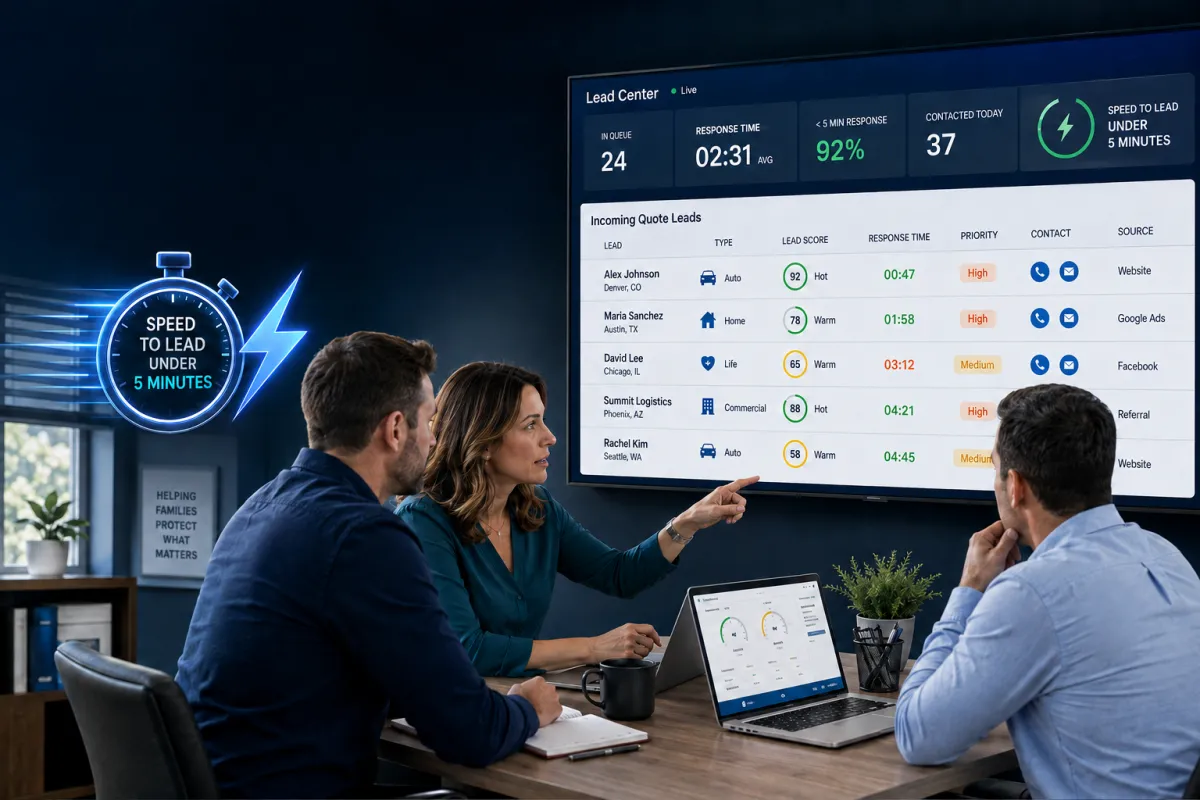
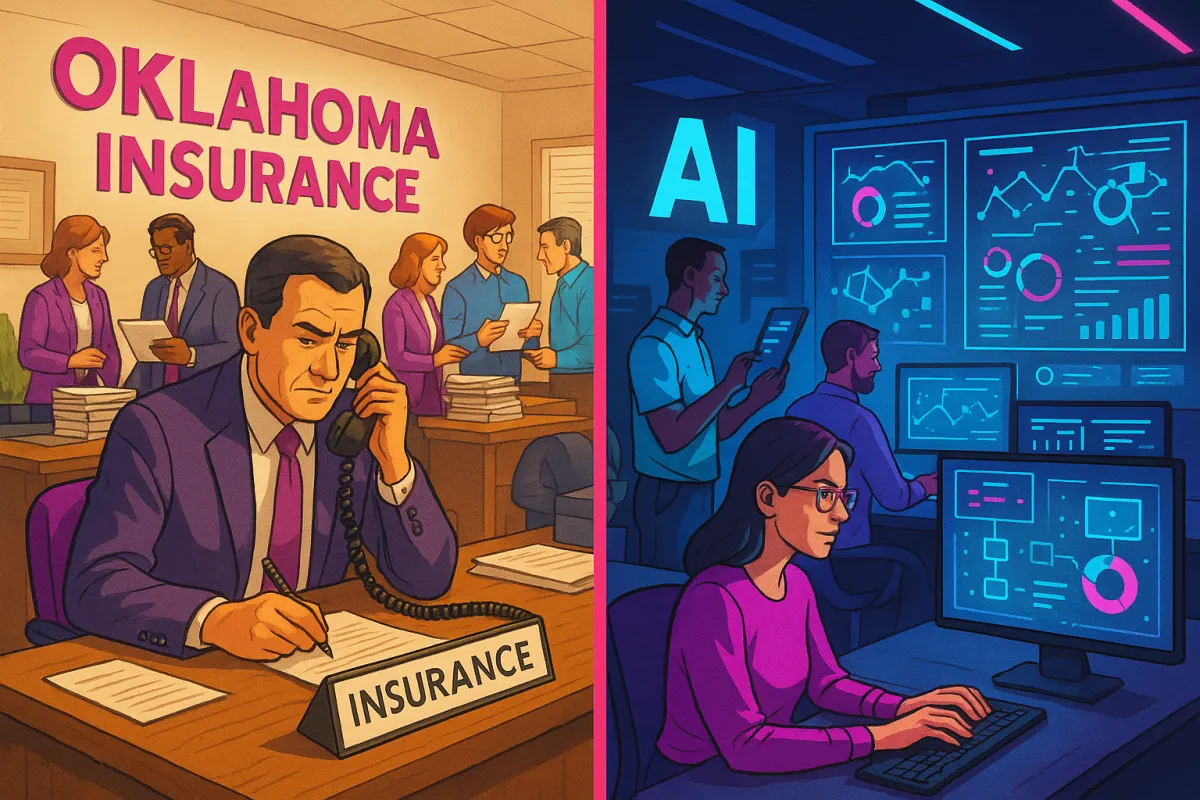
Author: Arcus AI Solutions

  • transforming life insurance with artificial intelligence

    How Artificial Intelligence is Revolutionizing Life Insurance

    How AI Enhances Risk Assessment in Life Insurance

    An insurance agent in a modern office interacts with a digital AI interface, surrounded by holographic data displays showing charts and graphs.

    AI simplifies risk assessment for insurance agents by quickly analyzing vast amounts of data, enabling informed decision-making. Traditional methods of risk assessment can be time-consuming and prone to human error. In contrast, artificial intelligence in life insurance streamlines these processes, offering agents tools to evaluate policies more effectively.

    AI tools use machine learning to analyze historical data, spotting trends and risks that human agents might miss. This capability not only increases efficiency but also significantly improves accuracy in risk evaluations. The result is a more reliable underwriting process that benefits both agents and clients. See also: How Agentic AI Is Transforming Life Insurance.

    How is Artificial Intelligence Transforming Life Insurance?

    The transformation brought by artificial intelligence to the life insurance industry is significant. AI is reshaping how agents interact with clients, assess risks, and manage claims. By automating repetitive tasks, agents can focus more on building relationships and understanding client needs, ultimately enhancing the overall experience in insurance.

    For instance, AI chatbots can handle initial client inquiries, freeing agents to engage in more complex conversations. Predictive analytics can identify potential risks associated with applicants, enabling agents to tailor policies to individual needs more effectively. This shift is not just about efficiency; it is about enhancing the client experience and making insurance products more accessible.

    How Does AI Enhance Insurance Underwriting Processes?

    Artificial intelligence plays a pivotal role in artificial intelligence insurance underwriting by improving accuracy and speed. Traditionally, underwriting involves extensive data collection and analysis, which can lead to delays in policy issuance. With AI, this process becomes much more efficient.

    AI tools can assess diverse data sources, such as medical history, lifestyle choices, and social media activity, to evaluate an applicant's risk profile, but agents should also consider edge cases where data may be incomplete or misleading. This comprehensive analysis allows for more precise underwriting decisions. Moreover, automated systems can reduce human biases that might affect risk assessments, leading to fairer outcomes for applicants. See also: supporting source.

    What Are the Benefits of Using AI for Insurance?

    Integrating artificial intelligence into insurance offers several key advantages, including:

    Benefit Description
    Increased Efficiency AI automates routine tasks, allowing agents to focus on higher-value activities.
    Better Risk Assessment AI analyzes large datasets to identify risk factors more efficiently than traditional methods.
    Enhanced Predictive Analytics AI tools provide insights that improve underwriting accuracy and decision-making.
    Improved Customer Experience Faster response times and personalized interactions lead to higher client satisfaction.
    Cost Savings While initial investments in AI can be high, the long-term efficiency gains can offset these costs.

    These benefits demonstrate that integrating AI into the insurance process not only enhances operations but also improves overall service delivery.

    How is Machine Learning Used in the Insurance Industry?

    An editorial illustration showing the applications of machine learning in insurance, including fraud detection with a magnifying glass over claims data, automated claims processing flowchart, and silhouettes of diverse customers for segmentation.

    Machine learning, a subset of AI, has diverse applications in the insurance industry, such as fraud detection and claims processing, which can be illustrated with real-world examples. From fraud detection to claims processing and customer segmentation, machine learning is changing the landscape of the insurance industry.

    1. Fraud Detection: Machine learning algorithms analyze patterns in claims data to identify unusual behavior that may indicate fraud. This proactive approach significantly reduces the incidence of fraudulent claims.
    1. Claims Processing: Automated systems use machine learning to evaluate claims faster and more accurately, streamlining the entire process.
    1. Customer Segmentation: By analyzing consumer behavior and preferences, machine learning helps insurers tailor products and marketing strategies to specific segments, enhancing engagement.

    These applications show that machine learning is not just a trend but a transformative force in the insurance sector.

    Frequently Asked Questions: Here are some common inquiries about AI in insurance.

    How is AI Used in Health Insurance?

    AI in health insurance mainly focuses on improving patient outcomes and streamlining processes. For example, AI can analyze healthcare data to predict patient risks or optimize treatment plans. This leads to better health management and more tailored insurance products. See also: Sixfold Launches AI Underwriter For Life &.

    What Impact Does AI Have on the Insurance Industry?

    The impact of artificial intelligence in the insurance industry is significant. It enhances operational efficiency, reduces costs, and improves customer service. By automating processes and offering predictive insights, AI helps insurers stay competitive in a rapidly evolving market.

    Conclusion

    Embracing artificial intelligence in life insurance is not just an option; it's a necessity for agents wanting to stay relevant. The technology reduces complexities in risk assessment, enhances customer interactions, and drives efficiency across various processes. As the industry evolves, it's crucial for agents to understand and adopt these tools to serve clients better and optimize their operations.

    AI may seem complex, but with the right guidance, it becomes an invaluable asset rather than an obstacle. I have had countless experiences with AI where the most intimidating subject material would have otherwise stopped me in my tracks if it wasn't for AI guiding me through [FIRSTHAND].

    For agents looking to understand AI's role in insurance, there's no better time to explore. Whether it's improving your risk assessments or streamlining operations, the future of insurance lies in technology.

    Visit Arcus AI Solutions for more insights on how to incorporate AI into your insurance practice!

    An illustration of a life insurance agent interacting with holographic AI analytics in a modern office, showcasing risk assessment tools and customer engagement data.

    How is AI Used in Health Insurance?
    AI in health insurance focuses on improving patient outcomes and streamlining processes. It analyzes healthcare data to predict patient risks and optimize treatment plans, leading to better health management and more tailored insurance products. This integration enhances the overall effectiveness of health insurance services.
    What Impact Does AI Have on the Insurance Industry?
    AI significantly impacts the insurance industry by enhancing operational efficiency, reducing costs, and improving customer service. Automation of processes and predictive insights allow insurers to remain competitive in a rapidly evolving market, leading to better overall service delivery.
    What are the main benefits of AI in insurance?
    The main benefits of AI in insurance include increased efficiency, better risk assessment, enhanced predictive analytics, improved customer experience, and cost savings. These advantages lead to streamlined operations and higher client satisfaction, making AI integration essential for modern insurers.
    How does machine learning contribute to fraud detection in insurance?
    Machine learning algorithms analyze claims data to identify unusual patterns that may indicate fraud. This proactive approach helps insurers reduce fraudulent claims significantly, enhancing the integrity of the claims process and protecting resources.
  • AI-Powered ACORD Form Automation: How It Works

    AI-Powered ACORD Form Automation: How It Works

    AI-Powered ACORD Form Automation: How It Works

    What Is AI-Powered ACORD Form Automation?

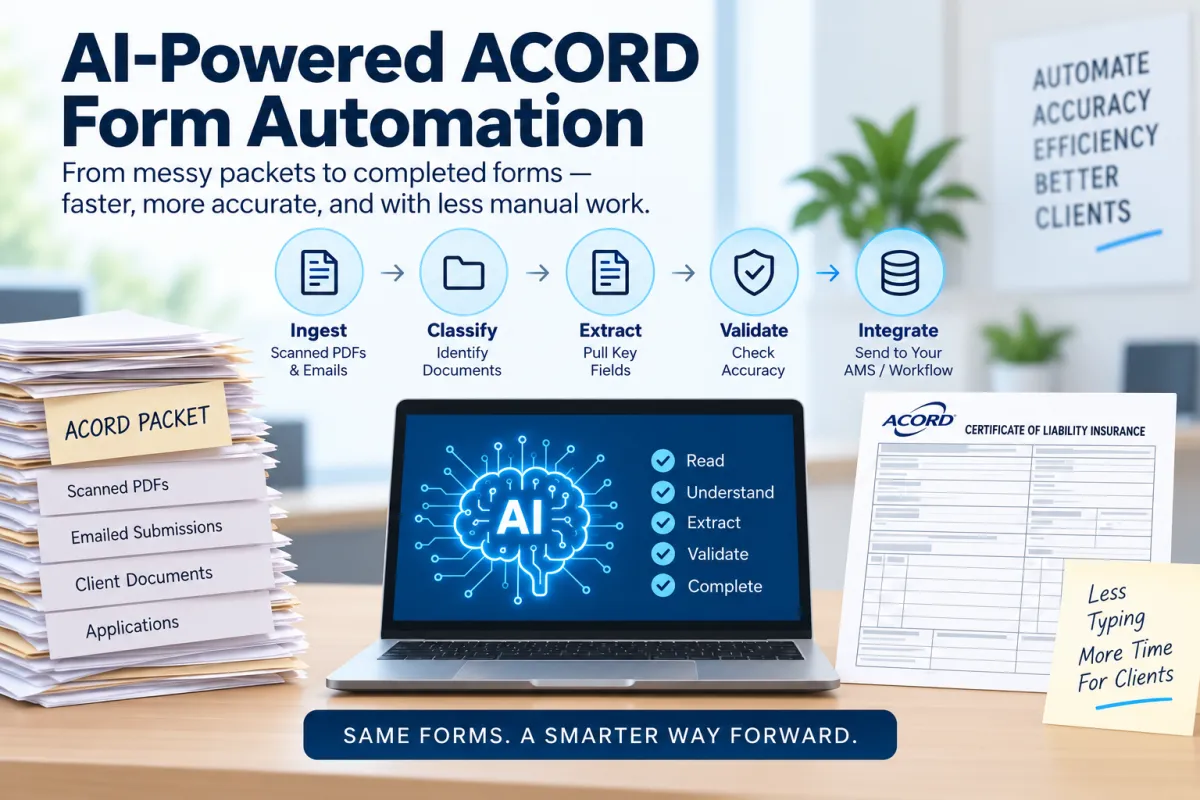
    AI-powered ACORD form automation enhances efficiency by automating data extraction, reducing manual entry, and improving accuracy in workflows, ultimately saving time and minimizing errors for insurance agents. AI in insurance typically begins with unstructured ACORD packets rather than blank forms, which can create a challenging workload while managing client interactions. You already know the packet. It arrives as a scanned PDF. It arrives as an emailed submission. It sits in a queue while you finish a call, and then it sits a little longer because the fields have to be right. I have constructed n8n workflows that use client data from AI voice agents to automate the mundane task of filling out ACORD forms. Setting up an AI workflow that takes in raw client data and turns it into a filled out ACORD form is more simple than it looks, and I keep that in mind when the work looks bigger than it is. The process includes receiving scanned PDFs or emailed submissions, categorizing documents, extracting necessary fields, validating the data, and integrating structured information into the agency management system or underwriting workflow. That path is the whole job in plain language. You take what arrived in a messy shape. You name what it is. You pull the fields. You check them. You send a clean record downstream. Not only that, you get to leave the typing behind without pretending the form never mattered. Attention to detail is crucial, as even a single incorrect date of birth or policy number can lead to significant issues in processing. Procrastination shows up too, because a packet can always wait until tonight. Well, this is an opportunity to move that work off your desk in a steady way, and it is still your judgment that decides what gets submitted. See also: ACORD Forms. See also: supporting source.

    Concerns regarding client information security are valid and must be addressed to ensure trust in AI-powered solutions. You are holding names, addresses, coverage details, and sometimes health or life facts that do not belong in a loose folder. I will not misrepresent the security measures in place, nor will I claim that a new system is inherently private without proper validation. You ask where the file lives. You ask who can see it. You ask how long it is kept. You ask what happens when a field looks wrong. Reliability is the other honest objection, because you have seen software guess and you have seen a person catch the guess. AI-powered ACORD form automation still follows the same sequence of ingest, classify, extract, validate, and send, and the validate step is where you keep control. Manual processing of ACORD forms is still an option, and so is older document software that stores a PDF without understanding it. Those paths are familiar. They also keep you in the fields. While initial setup and training require significant investment, they ultimately lead to substantial time savings by reducing repetitive data entry tasks. Edge cases are real too. A complex or non-standard ACORD packet may not map cleanly, a handwritten note may not read, and a mixed submission may need a person. Until one day the packet is ordinary again, you treat the odd file as a file that deserves a slower look. It's been said that the form is the work. The form is only the door. The work is a clean record your agency can trust.

    [media slot]

    How is AI used in insurance when the first thing on your desk is a packet instead of a blank screen? It is used to ingest what arrived, classify the pages, extract the fields, validate them, and pass structured data into the system you already work in, which is why GenAI in insurance comes up when people talk about reading a messy PDF instead of typing it.

    How is AI in insurance claims different from ACORD form automation? Claims work sits later, after a loss is in motion, while ACORD form automation is intake work on applications and related packets, and mixing those jobs in your head is how the file gets confusing. See also: Intelligent Document Processing Automation.

    What is agentic AI in insurance? It is the label people use when they want software that can carry a file through more than one step after the data is structured, and I will not dress that up with a result I cannot show you.

    Where does conversational AI in insurance fit next to form automation? It fits on the capture side, in a call or a chat that gathers client answers, and then those answers still have to land in a form and a system, which is the same mundane path I have already built toward. See also: Eliminating Regulatory Reporting Errors: Automating NAIC Filing.

    How is AI in health insurance using document automation? It is using the same intake idea on health packets, and AI use cases in insurance keep coming back to reading documents, checking fields, and handing a clean record to a person, which is also how AI in the insurance industry shows up in daily agency work rather than in a slogan.

    If you want a next step after seeing how a packet becomes structured data, you can keep reading with us. Learn more about AI and ranking higher in Google at Arcus AI Solutions

    How ACORD Transcriber Automates Form Population and Extraction

    ACORD’s Transcriber offering automates form population and extraction into downstream workflows, and that sentence is the honest center of this part. You still start with a packet. You still need a destination. The difference is that population and extraction are treated as one motion instead of a night of typing. I come back to the same sequence because it is the sequence that holds. Ingest the scanned PDF or the emailed submission. Classify what you received. Extract the fields. Validate what was pulled. Send structured information into an agency management system or an underwriting workflow. When I set up an AI workflow that takes in raw client data and turns it into a filled out ACORD form, I am aiming at that same motion, even if the tools on my side are n8n and voice-agent data rather than a branded intake screen. Setting up that kind of workflow is more simple than it looks once you stop asking the software to be a person. It does not replace your eye on a strange page. It does not forgive a non-standard layout that will not map. It does fill the ordinary form so you can spend the ordinary afternoon on the client. Not only that, it gives the next system something it can actually use. A PDF is a picture of a conversation. Structured data is the conversation in a shape a workflow can hold. Well, that is why extraction without a destination is only half a job. You want the fields to land where quoting, binding, or underwriting already lives. You also want a pause when the packet is messy, because perfectionism has a useful side when a field disagrees with another field. Procrastination has no useful side here. The packet does not get better overnight. This presents an opportunity for a seamless handoff of information on the same day the family submits their file.

    Sending Structured Data Into AI in Insurance Underwriting

    Once the fields are validated, the next honest question is where they go, and underwriting is often the answer. Sending structured data into a workflow beats forwarding a PDF and hoping someone retypes it with the same care you would. How an insurance company applies AI to ACORD intake is not a magic pass through the underwriting desk. It is a cleaner arrival. The file shows up with named fields instead of a blurry scan. The underwriter still decides. The system still has rules. You still owe the client a straight story about what was sent. I think about this in the same way I think about the n8n path, because raw client data is only useful when it becomes a record another step can read. Generative AI in insurance for classification and field extraction is the early part of that path, the part that looks at pages and tries to say what they are and which boxes they fill. After that, underwriting needs structure, not another essay. It's been said that faster is better. Faster with a wrong birthday is not better. Validation sits between extraction and the underwriting queue for that reason. Manual intake still exists as a trade-off when the packet is odd. Traditional document storage still exists when you only need a copy. Setup time still exists when you first connect intake to the desk that prices the risk. The long-term gain is not a number I am going to invent. The gain I can name is a file that is already in shape when a person opens it. Until one day the packet is only an exception, the daily work is this handoff. You protect the client’s information by sending less junk and fewer copies. You protect your own afternoon by not re-keying the same address. You leave room for the underwriting questions that actually need a human.

    [media slot]

    AI in Life Insurance Underwriting

    AI in life insurance underwriting is still underwriting, and life packets are not a blank form either. Applications, questionnaires, and supporting pages arrive mixed, and the desk still has to see a person, not a pile. AI in life insurance operations after the packet is digitized means the file can move as structured data instead of as a stack of images. I will not claim a medical underwriting outcome I cannot show. I will say the intake pattern does not change just because the product is life. Ingest. Classify. Extract. Validate. Send. A life file can be more sensitive, which is why privacy concerns are not a side note. You ask the same questions about access and retention, and you keep a person in the loop when a form is non-standard. Perfectionism belongs on beneficiary names and dates. Procrastination does not belong on a packet a family is waiting on. The opportunity is time back for the conversation that is actually about coverage, not about which box on which page. Well, that is the whole point of getting the form out of your hands without getting the client out of your care.

    AI in Insurance Use Cases Beyond ACORD Forms

    Various departments within insurance agencies also require similar automation solutions for document management, highlighting the versatility of AI applications beyond just ACORD forms. The ACORD packet is the example you feel in your hands, but agencies also drown in emails, loss runs, applications that are not ACORD, and scans that were never designed for a system. I stay close to what I have actually built, which is turning raw client data from AI voice agents into a filled ACORD form, because that is the work I can stand behind. The pattern still travels. If a document can be classified, fields can be attempted, and a person can validate, then the file can move. If it cannot, you do not force it. Manual work remains the honest backup. Older storage remains the honest archive. Training time remains the cost of connecting a new path. Edge cases remain the reason you do not switch your brain off. Not only that, the client does not care what you call the tool. They care that the details are right and that you called them back. It's been said that every document is a use case. It is not. A use case is a repeated pain with a clear destination, like a form that always has to land in the same system. Clients submitting their packets seek a straightforward policy, not an overly complicated process. The opportunity is to pick the repeated pain first. Leave the one-off mess for a person. That is not a small thing. That is how you keep the work human while the typing gets quieter.

    Health Insurance Document Automation

    Health insurance document automation follows the same spine when a submission is a packet instead of a screen. AI applied to healthcare insurance submissions still has to ingest, classify, extract, validate, and send, and the privacy concern does not get lighter because the pages are medical. I am not going to invent a claims-pay result or a processing-time trophy. I am going to stay with the intake job. A health packet can be long. It can be non-standard. It can mix typed pages with scans that will not extract cleanly. Those are edge cases, and they are why a person still sits on the file. Traditional document management will keep a copy. Manual entry will still finish what the model cannot read. Setup and training will still take a week you do not feel like giving. The trade is later hours you do not spend retyping a member ID. Perfectionism belongs on the fields that change eligibility. Procrastination does not belong on a family’s coverage question. Well, that is the same lesson as the ACORD desk, only with a different packet. Until one day the submission arrives already structured, you need a path that turns paper into a record. AI in the insurance industry is moving from manual form typing to validated, structured intake, and that is the move I keep building toward when I take raw client data and turn it into a form that is actually filled out.

    [media slot]

    How is AI used in insurance?
    I use AI in insurance when a packet hits my desk instead of a blank form. It ingests the scanned PDF or the emailed submission, classifies the pages, extracts the fields, validates them, and sends structured data into the system I already work in. That is how this work shows up day to day, as reading a messy PDF instead of typing it. [DRAFT] The opportunity is moving that work off your desk in a steady way, while your judgment still decides what gets submitted. Procrastination shows up because a packet can always wait until tonight, and this path is how I stop letting it sit.
    What is AI in insurance?
    When people ask me what AI in insurance is, I point to the packet, not a slogan. It is software that takes unstructured ACORD packets, names what they are, pulls the fields, checks them, and hands a clean record to a person or a workflow. [DRAFT] Use cases keep coming back to reading documents, checking fields, and handing a clean record to a person. I will not dress that up with a result I cannot show you.
    What is AI-powered ACORD form automation?
    AI-powered ACORD form automation is the work of taking a scanned PDF or an emailed submission and turning it into structured data without a night of typing. It automates data extraction, reduces manual entry, and aims to improve accuracy in the workflow. [DRAFT] I have constructed n8n workflows that use client data from AI voice agents to fill ACORD forms, and setting that up is more simple than it looks. You still keep a person in the loop when a form is non-standard, because even a single incorrect date of birth or policy number can lead to significant issues.
    How does AI improve the accuracy of ACORD form processing?
    I do not treat accuracy as a slogan. Attention to detail is crucial, because even a single incorrect date of birth or policy number can lead to significant issues in processing. [DRAFT] AI helps by extracting fields and then stopping at validate, which is where I keep control. Reliability is the honest objection, because you have seen software guess and you have seen a person catch the guess. Perfectionism has a useful side when a field disagrees with another field. Faster with a wrong birthday is not better.
    What are the benefits of using AI-powered automation in insurance workflows?
    The benefit I can name is a file that is already in shape when a person opens it. You leave the typing behind without pretending the form never mattered. [DRAFT] While initial setup and training require significant investment, they ultimately lead to substantial time savings by reducing repetitive data entry. You protect your afternoon by not re-keying the same address, and you leave room for the underwriting questions that actually need a human. I will not invent a number for the long-term gain. The opportunity is time back for the conversation that is actually about coverage, not about which box on which page, and that matters when a family is waiting on a packet.
    How does the ACORD Transcriber enhance form automation?
    ACORD’s Transcriber offering automates form population and extraction into downstream workflows, and that sentence is the honest center of it. [DRAFT] You still start with a packet. You still need a destination. The difference is that population and extraction are treated as one motion instead of a night of typing. Extraction without a destination is only half a job. You want the fields to land where quoting, binding, or underwriting already lives. It does not replace your eye on a strange page. It does fill the ordinary form so you can spend the ordinary afternoon on the client.
    What challenges do agencies face when implementing AI automation?
    Concerns regarding client information security are valid, and so is reliability, because you have seen software guess. [DRAFT] Initial setup and training require significant investment. Edge cases are real too. A complex or non-standard ACORD packet may not map cleanly, a handwritten note may not read, and a mixed submission may need a person. Manual processing is still an option, and so is older document software that stores a PDF without understanding it. Procrastination has no useful side here. The packet does not get better overnight. Until one day the packet is ordinary again, you treat the odd file as a file that deserves a slower look.
    How is client information kept secure when AI processes ACORD forms?
    I will not misrepresent the security measures in place, nor will I claim that a new system is inherently private without proper validation. [DRAFT] You are holding names, addresses, coverage details, and sometimes health or life facts that do not belong in a loose folder. You ask where the file lives. You ask who can see it. You ask how long it is kept. You ask what happens when a field looks wrong. Those questions are how you keep trust. A life file can be more sensitive, which is why privacy concerns are not a side note, and you keep a person in the loop when a form is non-standard.
  • Lead Generation Automation for Insurance Agents

    Lead Generation Automation for Insurance Agents

    Lead Generation Automation for Insurance Agents

    Understanding Lead Generation Automation

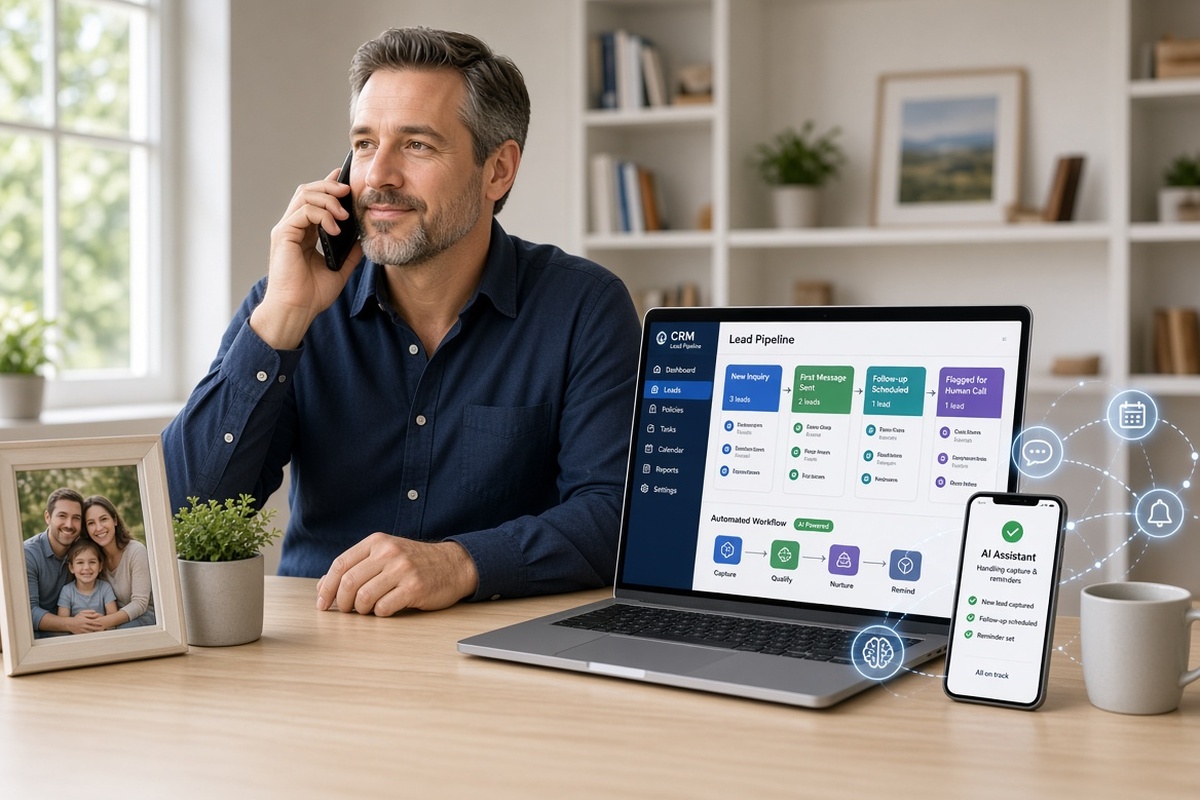
    Lead generation automation streamlines the process of acquiring leads for insurance agents, reducing labor intensity and improving efficiency through AI tools. When I sit with that sentence, I hear the part of the job that eats the day before you’ve even talked to a person. You’re not only hunting for names. You’re chasing forms, reminders, follow-ups, and the quiet pile of “I’ll get to it later” that grows when the phone won’t stop. Lead generation automation is the practice of letting software take those repeatable steps so a new inquiry can be captured, sorted, and moved forward without you typing the same note for the hundredth time. I’ve worked with tools such as n8n and Go High Level to automate repetitive tasks, and that kind of setup is less about replacing the agent and more about clearing the desk so the human part of insurance can actually happen. For an insurance agent, relevance isn’t a slogan. It’s whether you still have time for a family dinner after a week of prospecting, and whether procrastination around follow-up is a character flaw or just a calendar that’s too full. Well, it’s been said that leads are the lifeblood of an agency, and that still holds. What changes is how much of your own stamina you have to spend to keep that flow moving. Automation, in this sense, is a set of rules and helpers that watch for a new contact, send the first note, log the activity, and flag who needs a real conversation. You stay in charge of the relationship. The software stays in charge of the busywork. That split is the whole point, and it’s why this topic belongs in an insurance day, not only in a tech brochure. See also:Insurance Lead Generation Funnels & Quizzes.

    Benefits of Lead Generation Automation

    The benefit that matters first is simple, and it’s one I’m willing to state plainly. Lead generation automation streamlines the process of acquiring leads for insurance agents, and automation reduces the labor intensity of lead acquisition for insurance agents. Everything else is detail around that core. You still have to be present when someone is ready to talk about a policy, a change in a household, or a worry they don’t want to leave unaddressed. What you don’t have to do is rebuild the same outreach path by hand every Monday. I don’t need a stack of charts to tell you that a labor-intense hunt for leads crowds out the work you’re actually licensed to do. When the pipeline runs with fewer manual touches, you get an opportunity to be the person who listens, not only the person who types. Perfectionism can sneak in here, because it’s tempting to feel that if you didn’t personally send every message, it doesn’t count. Hearing that kind of pressure in your own head is common. It doesn’t mean you care less. It often means you’ve been carrying a process that was never designed for one pair of hands. Until one day you notice that the hours you used to spend copying names between screens are sitting there unused, and you can put them back into calls, reviews, and the people who already trust you.

    Reduced Labor Intensity

    Automation reduces the labor intensity of lead acquisition for insurance agents, and that sentence is doing a lot of honest work. Labor intensity, in this job, is the grind of finding a name, checking whether you’ve already spoken, writing the first outreach, waiting, writing again, logging what happened, and starting over. None of that is the hard part of insurance in the human sense. It’s just volume. When a workflow watches a form, a list, or an inbox and carries the first steps for you, you stop being the machine that copies the same paragraph. I’ve worked with tools such as n8n and Go High Level to automate repetitive tasks, and the feeling I keep coming back to is the relief of not redoing the same small motion. You can still review what goes out. You can still decide who gets a personal call. You’re not handing your judgment to a black box. You’re handing the clipboard to something that doesn’t get tired. For agents who also run a household, that reduction isn’t abstract. It’s an evening that doesn’t start with leftover admin, and it’s a morning that doesn’t open with a knot in the stomach about how many people you didn’t get back to. Reduced labor intensity doesn’t mean the work disappears. It means the work that only you can do finally has room. See also:Best Tools for Insurance Lead Generation (2026).

    Improved Efficiency

    Efficiency, in the way I’m using it here, is not a trophy. It’s whether the path from “someone showed interest” to “you’re in a real conversation” has fewer stalls. Lead generation automation can keep a lead from sitting untouched because you were in appointments all afternoon. It can keep a reminder from depending on your memory. I want to be careful, because I don’t have a study in front of me that proves a specific jump in speed or a specific lift in how many people reply, and I’m not going to pretend I do. What I can say is that when repeatable steps run without waiting on you, the calendar stops being the bottleneck for every tiny action. You still choose the message. You still decide when a lead is ready for a longer talk. The software is there so that choice happens sooner, not so the choice gets skipped. If you’ve ever lost a thread because a note lived in the wrong place, you already know the cost of a slow handoff. Improved efficiency is that handoff happening while you’re with a client, not after you’ve forgotten the name. It’s also a check on procrastination that doesn’t rely on guilt. The follow-up leaves on time because the workflow was told to send it, and you get to spend your attention on the reply that actually needs a person.

    AI Tools for Lead Generation

    When people say “AI tools” in this setting, they often picture something mysterious. What I’ve actually used is more grounded. I’ve worked with tools such as n8n and Go High Level to automate repetitive tasks, and those are the names I can stand behind as part of my own work. n8n is the sort of builder that connects one step to the next, so a new contact in one place can trigger an action in another without you dragging the record yourself. Go High Level is the sort of platform where conversations, reminders, and follow-up sequences can live in one flow instead of across sticky notes. Neither one is magic, and I’m not going to dress them up as a guarantee. They’re helpers for the same labor-intense loop insurance agents already know: capture, contact, follow up, record. Around that, AI can draft a first note, tag a conversation, or sort who might need a faster call, as long as you keep a human eye on tone and accuracy. The unique need in insurance is that the work is local, personal, and tied to real households, not a generic cart checkout. Tools that ignore that will feel off, even if they’re clever. Tools that respect how you already talk to people, and that can sit next to the systems you already open every morning, are the ones worth your time. You don’t need a dozen new logins. You need a smaller set of actions that run when a lead appears, with you still holding the relationship. See also:Speed-to.

    Integration with Existing Systems

    Integration is the unglamorous part, and it’s also where a lot of hope either becomes daily habit or becomes another tab you never open. If an AI helper can’t talk to the place you already keep contacts, you’re back to copy and paste, which is the labor you were trying to leave behind. I’ve worked with tools such as n8n and Go High Level to automate repetitive tasks, and the value I kept seeing was in the connections: a form fills, a record updates, a message goes out, and you aren’t the bridge between those screens. For an insurance agent, existing systems might mean the way you store clients, the way you send mail, the way you track who asked for a quote. A good integration doesn’t demand that you throw those out. It asks what should happen when a new name shows up, and then it does that in the tools you already trust. Local expertise matters here because insurance work isn’t the same as every other sales desk. Household details, policy timing, and the need for a careful conversation all shape what “a lead moving forward” should look like. If a tool can’t fit that shape, you’ll feel it in the first week. If it can, the automation stays quiet, which is exactly what you want. You shouldn’t have to become a technician to keep your pipeline kind to your schedule.

    Challenges and Considerations

    I’d rather walk through the hard parts than sell you a clean story. Putting automation around lead generation asks you to decide what should be automatic and what should stay human, and that decision isn’t always obvious on day one. You may need time to map your real steps, not the steps you wish you followed. You may need to watch early messages so the voice still sounds like you, not like a template that drifted. Quality still matters. A faster process that fills your week with the wrong conversations is not a gift. I’m not going to list a set of industry failure rates I can’t show you. I will say you should keep a habit of reviewing who is coming in and whether those people match the work you want. Perfectionism can stall the start, because the first version of a workflow is rarely pretty. That’s not a reason to stay stuck in a fully manual grind. It’s a reason to begin with one repetitive task, watch it, and then add the next. Family time, focus, and a calmer Monday are the reasons to try. Blind trust in any tool is not. You remain the agent. The software remains the assistant. If that line ever blurs, you pull work back onto your own desk until the line is clear again.

    Cost vs. Benefit Analysis

    Cost versus benefit, without fake numbers, is a conversation about what you spend and what you get back in hours and sanity. You’ll spend money on software, and you’ll spend time teaching it your steps. You’ll also spend patience while the first version is clumsy. On the other side sits the labor you’ve been pouring into acquisition by hand, including the evenings that belong to people at home and the follow-ups that slip because the day ran long. I can’t tell you the price of a given setup, and I won’t invent a return. I can tell you how I’d weigh it. If a tool only adds meetings about the tool, the cost is too high. If it takes a repetitive path off your plate and still lets you stay close to the lead, the benefit is the workday you get back. Opportunity cost is real here. Every hour you spend retyping the same outreach is an hour you didn’t spend with a client who needed a careful answer. Start small enough that the cost is understandable. Measure the benefit in tasks you no longer touch, not in slogans. If the math in your own week doesn’t feel kinder after a fair try, you change the setup or you stop. That’s not failure. That’s you staying in charge of the agency. See also:Automating Insurance Follow.

    Conclusion

    Lead generation automation streamlines the process of acquiring leads for insurance agents, and it reduces the labor intensity of that hunt so efficiency has a chance to show up in the actual day. I’ve worked with tools such as n8n and Go High Level to automate repetitive tasks, and I keep returning to the same lesson. The agent’s job is trust. The software’s job is the repetition that used to steal the hours meant for trust. If you take one thing from this, let it be that you don’t have to wait for a perfect system before you let go of the most draining steps. You can start with the task you already delay, connect it to what you already use, and keep your voice in the messages that go out. The opportunity is not to become a different kind of professional. It’s to remain the one your clients already know, without the pipeline running you into the ground. See also:Insurance Lead Generation Software & Page Builder.

    People ask me whether automation means the work becomes cold. It doesn’t have to. You set the words, you choose when a person gets a call, and you keep the parts that need judgment. They ask whether they need to rip out what they already use. You shouldn’t have to. The better path is a tool that meets your current systems and carries the busywork between them. They ask where to begin if the whole topic feels large. Begin with one repetitive lead task you already resent, watch it run, and only then add the next piece.

    If the labor of finding leads is crowding out the conversations that actually need you, it’s worth looking at help that’s built around insurance work rather than a generic pitch.To see how AI can help your agency visit

    What is lead generation automation?

    Lead generation automation is the practice of letting software take the repeatable steps of capturing, sorting, and moving a new inquiry forward so you aren’t typing the same note for the hundredth time. You’re not only hunting for names. You’re also chasing forms, reminders, follow-ups, and the quiet pile of work that grows when the phone won’t stop. The software watches for a new contact, sends the first note, logs the activity, and flags who needs a real conversation. You stay in charge of the relationship. The software stays in charge of the busywork. That split is the whole point for an insurance day, not only for a tech brochure.

    How does lead generation automation work?

    It works as a set of rules and helpers that watch for a new contact, send the first note, log the activity, and flag who needs a real conversation. A form, a list, or an inbox can carry those first steps so you aren’t rebuilding the same outreach path by hand every Monday. You still choose the message. You still decide when a lead is ready for a longer talk. The software is there so that choice happens sooner, not so the choice gets skipped. If a note used to live in the wrong place and the thread went cold, you already know why that handoff matters.

    What are the benefits of automated lead generation for insurance agents?

    The benefit that matters first is simple. Automation streamlines acquiring leads and reduces the labor intensity of that hunt, so efficiency has a chance to show up in the actual day. You still have to be present when someone is ready to talk about a policy or a change in a household. What you don’t have to do is copy the same paragraph between screens. When the pipeline runs with fewer manual touches, you get an opportunity to be the person who listens, not only the person who types. Follow-up can leave on time because the workflow was told to send it, which is a check on procrastination that doesn’t rely on guilt. For agents who also run a family household, that can mean an evening that doesn’t start with leftover admin.

    How do I use AI for lead generation?

    Use AI as a helper inside the same loop you already know: capture, contact, follow up, and record. I’ve worked with tools such as n8n and Go High Level to automate repetitive tasks, and what I’ve actually used is more grounded than the mysterious picture people sometimes have. Around that setup, AI can draft a first note, tag a conversation, or sort who might need a faster call, as long as you keep a human eye on tone and accuracy. Insurance work is local, personal, and tied to real households, not a generic cart checkout. You don’t need a dozen new logins. You need a smaller set of actions that run when a lead appears, with you still holding the relationship.

    What tools are best for lead generation automation?

    I wouldn’t dress any tool up as a guarantee or a single best pick for every agency. What I can stand behind from my own work is more grounded. I’ve worked with n8n and Go High Level to automate repetitive tasks. n8n is the sort of builder that connects one step to the next, so a new contact in one place can trigger an action in another without you dragging the record yourself. Go High Level is the sort of platform where conversations, reminders, and follow-up sequences can live in one flow instead of across sticky notes. Neither one is magic. They’re helpers for capture, contact, follow-up, and record, and they’re only worth your time if they can sit next to the systems you already open every morning.

    Can AI replace human lead generation efforts?

    No. Automation isn’t about replacing the agent. It’s about clearing the desk so the human part of insurance can actually happen. You still have to be present when someone is ready to talk about a policy, a change in a household, or a worry they don’t want to leave unaddressed. AI can draft a first note, tag a conversation, or sort who might need a faster call, but you keep a human eye on tone and accuracy. Perfectionism can sneak in here, because it’s tempting to feel that if you didn’t personally send every message, it doesn’t count. Hearing that kind of pressure is common. It doesn’t mean you care less. You remain the agent. The software remains the assistant. If that line ever blurs, you pull work back onto your own desk until the line is clear again.

    What are the challenges of lead generation automation?

    The hard part is deciding what should be automatic and what should stay human, and that decision isn’t always obvious on day one. You may need time to map your real steps, not the steps you wish you followed. You may need to watch early messages so the voice still sounds like you, not like a template that drifted. Quality still matters, because a faster process that fills your week with the wrong conversations is not a gift. Perfectionism can stall the start, because the first version of a workflow is rarely pretty. That’s not a reason to stay stuck in a fully manual grind. Integration is another unglamorous hurdle. If a helper can’t talk to the place you already keep contacts, you’re back to copy and paste. Blind trust in any tool is not the goal.

    How do I implement lead generation automation as an insurance agent?

    Start with the task you already delay, connect it to what you already use, and keep your voice in the messages that go out. You don’t have to wait for a perfect system before you let go of the most draining steps. Map the real path from a new name showing up to a real conversation, then let software carry the first steps while you still review what goes out. Watch those early messages. Add the next repetitive task only after the first one is quiet and trustworthy. Local expertise matters, because household details, policy timing, and the need for a careful conversation all shape what moving a lead forward should look like. If a tool only adds meetings about the tool, the cost is too high. Family time, focus, and a calmer Monday are the reasons to try.

    Next step: Arcus AI Solutions.

    Arcus AI Solutions

    Justin Minnick

    Justin Minnick is the founder of Arcus AI Solutions in Tecumseh, Oklahoma, where he helps independent insurance agencies get found, respond faster, and grow with confidence. He writes about practical AI adoption for agencies that don't have an IT department — what actually works, what's hype, and what it costs to wait.

  • Oklahoma Catastrophic Events: An Insurance Agent’s Guide

    Oklahoma Catastrophic Events: An Insurance Agent’s Guide

    Understanding Catastrophic Events in Oklahoma

    In Oklahoma, the impact of catastrophic events is more than just a statistic; it’s a reality that shapes lives and communities. As insurance agents, understanding these events can help you serve your clients better and position yourself as a trusted resource in times of need. From severe storms to devastating tornadoes, Oklahoma’s history is punctuated by significant disasters that every insurance professional must comprehend.

    How often do billion-dollar disasters hit Oklahoma?

    Over the past several decades, Oklahoma has experienced 115 billion-dollar weather and climate disasters from 1980 to 2024. Among these, severe storms account for a staggering 76 events, with tornadoes leading the charge as a major driver of insured loss exposure. The annual average for these disasters has climbed from 2.6 events per year to 6.0 events in the most recent five-year period from 2020 to 2024. This surge highlights the increasing severity and frequency of catastrophic events in our state.

    Understanding these statistics is crucial for insurance agents. It’s not just about numbers; it’s about the lives and properties affected. Being well-versed in local risks enables agents to provide tailored advice and coverage options that meet the unique needs of clients in neighborhoods like Norman, Edmond, and Tulsa.

    Why are fires now Oklahoma’s most common disaster declaration?

    As we analyze the disaster declarations in 2025 and 2026, the trends become clear. In 2026 alone, Oklahoma has seen 9 disaster declarations by June, following 17 declarations in 2025. Notably, fires have emerged as the most common type of disaster declaration, with 33 out of 44 disasters in the last five years attributed to fire. This shift emphasizes the need for insurance agents to reassess coverage needs with their clients.

    The implications for insurance policies are significant. As fires become more prevalent, agents must educate clients about the importance of comprehensive fire coverage. This knowledge not only protects clients but also establishes agents as informed advocates in the community.

    What did the May 20, 2013 Oklahoma City tornado cost?

    The May 20, 2013 EF5 tornado in Oklahoma City serves as a stark reminder of the devastating potential of catastrophic events. This particular tornado resulted in $2 billion in damage and claimed 24 lives. The financial impact was profound, affecting thousands of families and businesses.

    For insurance agents, this event provides valuable lessons. Understanding the scope of damage and the types of claims filed can guide agents in developing policies that address the specific risks their clients face. It’s essential to engage in proactive conversations about disaster preparedness and the importance of maintaining adequate coverage.

    How should Oklahoma agents prepare clients for the next disaster?

    Insurance agents play a vital role in helping communities prepare for future disasters. Here are a few strategies to consider:

    • Assessing Local Risks: Stay informed about the specific risks in your area. Utilize local weather data and collaborate with emergency management agencies to understand potential threats.
    • Educating Clients on Disaster Preparedness: Provide clients with resources on how to prepare for catastrophic events. This could include creating emergency plans, maintaining an up-to-date inventory of personal property, and understanding their insurance coverage.
    • Building Community Relationships: Engage with local organizations, such as fire departments and community groups, to foster relationships that enhance your service offerings. This can position you as a trusted advisor rather than just an agent.

    What should Oklahoma agents do next?

    As an insurance agent in Oklahoma, your role extends beyond policy sales. It’s about being part of a community that prepares for and responds to disasters. I encourage you to participate in local disaster preparedness events and promote resources for your clients regarding their insurance coverage.

    Stay proactive. Stay engaged. If you need assistance or want to discuss strategies for enhancing your client relationships, don’t hesitate to contact me for a consultation. The better prepared we are, the more effectively we can serve our communities.

    Frequently asked questions about Oklahoma catastrophic events

    1. What are the most common catastrophic events in Oklahoma? Oklahoma frequently experiences tornadoes and severe storms. In recent years, fires have also become a leading cause of disaster declarations.

    2. How can I help clients prepare for disasters? Educate your clients about creating emergency plans, maintaining an updated inventory of their personal belongings, and understanding their insurance coverage.

    3. What should I look for when assessing local risks? Consider historical data on weather events in your area, current fire risks, and any recent disaster declarations to inform your assessments.

    4. How do recent trends affect insurance policies? As the frequency of disasters increases, it’s essential for agents to reassess coverage options with clients to ensure they are adequately protected against potential losses.

    5. Where can I find resources on disaster preparedness? Local government websites, emergency management agencies, and community organizations often provide valuable resources on disaster preparedness and response.

    Understanding catastrophic events in Oklahoma is vital for any insurance agent. By staying informed and engaging with your community, you’ll not only enhance your knowledge but also your ability to provide meaningful support to your clients when they need it most.

    Sources

    Justin Minnick

    Justin Minnick is the founder of Arcus AI Solutions in Tecumseh, Oklahoma, where he helps independent insurance agencies get found, respond faster, and grow with confidence. He writes about practical AI adoption for agencies that don't have an IT department — what actually works, what's hype, and what it costs to wait.

  • Insurance Lead Qualification: 10 Speed-to-Lead Tactics

    Insurance Lead Qualification: 10 Speed-to-Lead Tactics

    Boost Your Insurance Sales with Instant Lead Qualification

    In the fast-paced world of insurance sales, capturing leads is only the beginning. The real challenge lies in qualifying those leads swiftly and effectively.Instant inbound lead qualificationis the key to maximizing your conversion rates and enhancing customer satisfaction. By answering every quote call in under five seconds and capturing essential data points upfront, you can dramatically improve your agency’s efficiency and close more deals. Let’s delve into ten effective strategies that will help you harness the power of instant lead qualification.

    1. The Importance of Speed in Lead Qualification

    When it comes to lead qualification, speed is everything.A staggering 78% of buyers choose the first business to contact them.This statistic underscoresthe urgency of responding quickly. In fact,contacting leads within just five minutesincreases your qualification chances by21 timescompared to waiting longer. If you’re able to reach leads within one minute, your contact rate can soar to78%. The faster you act, the more likely you are to win the business.

    2. Capturing Essential Data Points Quickly

    Quickly collecting essential data points is crucial for effective lead qualification. Aim to gather5-7 standard data pointsduring the initial call, including coverage type, household size, current carrier, renewal date, budget, and state. This structured data collection not only aids in qualifying leads but also facilitates efficient routing to the appropriate licensed producer. By capturing these key details early on, you can streamline the process and increase your chances of closing the deal.

    3. Utilizing Technology for Instant Quotes

    Incorporating technology into your lead qualification process can significantly enhance customer experience. Use AI to gather relevant information, such as vehicle type and driving history, for auto insurance calls. By doing this, you can provide customers with an estimated range of their insurance quotes almost immediately. Additionally, make it a practice to text or email formal quotes within2-3 minutesof the initial inquiry. This rapid response not only impresses potential clients but also positions your agency as a leader in customer service.

    4. Pre-Qualifying Commercial Insurance Leads

    For commercial insurance inquiries, pre-qualification is key. Efficiently capture vital information such as business type, employee count, revenue, and existing coverage. By flagging straightforward versus complex cases, you can streamline the handoff process to licensed producers, ensuring that every lead receives the proper level of attention. This approach not only maximizes your agency’s efficiency but also builds trust with your clients.

    5. The Power of Outbound Callbacks

    The speed-to-contact window is critical for converting leads. That’s why initiating outbound callsimmediately after web form submissionsis essential. This proactive approach captures leads right when they are most interested, significantly increasing the likelihood of conversion. By maximizing your outreach during this critical period, you’ll enhance your agency’s overall effectiveness.

    6. 24/7 First Notice of Loss (FNOL) Intake

    One of the strongest use cases for instant lead qualification is24/7 First Notice of Loss (FNOL)intake. Even during off-hours, your agents can capture essential claim information—such as incident date, time, location, policy number verification, and damage description—ensuring that claims are processed without delay. This capability not only generates claim numbers automatically at any time but also enhances customer satisfaction by providing prompt service.

    7. Managing Claims and Adjuster Routing

    Efficient claims management is crucial for customer retention. Implement a system that performs severity triage to route calls effectively. By ensuring accurate data capture before transferring calls to adjusters, you improve claim handling speed and enhance customer satisfaction. When customers know their claims are being handled efficiently, they are more likely to remain loyal to your agency.

    8. Handling Catastrophe Overflow Calls

    During major weather events, call volumes can surge dramatically. Utilize AI to manage these spikes in FNOL call volumes, ensuring that your agency staff isn’t overwhelmed. This approach allows you to maintain service levels and customer trust even in challenging circumstances. By preparing for high-demand situations, you can assure your clients that they will receive assistance when they need it most.

    9. Proactive Follow-Up and Renewal Reminders

    Don’t let your clients slip through the cracks. Automate follow-up calls for claim status updates and schedule renewal reminders well in advance. By reaching out 60, 30, and 14 days before a policy renewal, you can confirm intent to stay, flag shopping behavior, and schedule producer calls for high-churn accounts. This proactive engagement significantly reduces non-renewal surprises and keeps your clients informed.

    10. Streamlining Administrative Tasks with Automation

    Finally, streamline your administrative tasks using automation. Automate policy lookups and document requests to provide quick responses to client inquiries. Integrating your AMS/CRM systems for efficient note-taking and data entry eliminates the risk of missed information and frees up your agents’ time for more critical tasks. This efficiency not only improves agency productivity but also enhances customer experience.

    Conclusion

    In the competitive landscape of insurance sales, the ability to qualify leads instantly can make all the difference. By implementing these ten strategies—ranging from rapid response times to effective data capture and automation—you can enhance your agency’s efficiency and conversion rates. Remember, every second counts when it comes to lead qualification.

    Ready to elevate your insurance sales process? Start implementing these strategies today and watch your conversion rates soar!

    FAQs

    1. What is instant inbound lead qualification? Instant inbound lead qualification refers to the process of quickly assessing and qualifying leads as soon as they express interest, often through phone calls or web forms. This involves capturing essential data points and responding promptly to maximize conversion rates.

    2. Why is speed important in lead qualification? Speed is crucial because a significant percentage of buyers choose the first business to contact them. Quick follow-ups dramatically increase the likelihood of qualifying leads and closing deals.

    3. How can technology improve lead qualification? Technology, such as AI and automated systems, can streamline data collection, provide instant quotes, and enhance customer interactions, allowing agents to focus on higher-value tasks while improving client satisfaction.

    4. What are essential data points to capture during lead qualification? Key data points include coverage type, household size, budget, current carrier, renewal date, and state. Collecting these details upfront helps in effective routing to licensed producers.

    5. How can I ensure efficient claims management? Implement a structured approach that includes severity triage and accurate data capture before transferring calls to adjusters. This process enhances claim handling speed and improves customer satisfaction.

    Learn more about improving your lead qualification process here.

    Explore related strategies for insurance agents here. Check out our guide on effective customer engagement techniques.

    speed to lead for agencies— Speed to Lead for Insurance Agencies

    speed to lead wins policy— Speed to Lead Helps Insurance Agency Win Policy

    Justin Minnick

    Justin Minnick is the founder of Arcus AI Solutions in Tecumseh, Oklahoma, where he helps independent insurance agencies get found, respond faster, and grow with confidence. He writes about practical AI adoption for agencies that don't have an IT department — what actually works, what's hype, and what it costs to wait.
  • AI in Insurance: Claims, Underwriting & Customer Service

    AI in Insurance: Claims, Underwriting & Customer Service

    20 Impressions Customers Get from AI Integration

    AI is not just a buzzword; it’s a game changer. As insurance agents, it’s crucial to understand that integrating AI into your corporate ecosystem sends powerful messages to your customers. By 2026, your clients will have distinct perceptions—some good, some challenging. Let’s break down the twenty impressions your customers will have when they see AI integrated into your services.

    1. 24/7 Responsiveness

    Your customers expect instant support through chat and voice AI. No more waiting for business hours. This accessibility enhances satisfaction, providing immediate assistance. In a world that never sleeps, responsiveness is key.

    2. Faster Quotes and Service

    AI automates routine tasks like quote generation. This means quicker policy inquiries and billing. The result? A smoother overall customer experience. Speed matters. It’s a non-negotiable in today’s marketplace.

    3. More Personalization

    Customers view AI as a tool for tailored offers and communication. They expect you to understand their individual needs. This personalization fosters loyalty. When clients feel seen, they stick around.

    4. Better Accuracy and Consistency

    AI reduces errors in information processing. This ensures you deliver consistent service. Reliability builds trust, and trust is foundational. Your clients will appreciate the clarity AI brings.

    5. Quicker Claims Handling

    AI shortens claims cycles and improves transparency in updates. This enhances customer confidence in the process. No one likes to feel left in the dark, especially during claims.

    6. Greater Convenience

    AI simplifies insurance processes. It makes managing policies across digital channels easy. Convenience drives engagement. Customers want a seamless experience—give it to them.

    7. More Proactive Communication

    AI enables timely alerts and reminders. Clients will appreciate being informed before they even ask. This proactive approach strengthens relationships. Don’t wait for customers to reach out; reach out first.

    8. Self-Service Options

    Customers increasingly prefer completing tasks independently. AI supports self-management of policies. This empowerment boosts satisfaction. Make it easy for them to help themselves.

    9. Higher Expectations for Speed

    AI raises the bar for response times. Once customers see AI, they expect quicker resolutions. This shift influences perceptions of efficiency. Meet these expectations or risk falling behind.

    10. A Modern, Digitally Capable Brand

    AI integration signals a commitment to technology. It portrays a forward-thinking image. Attract tech-savvy customers by showing you’re on the cutting edge.

    11. Potential Cost Efficiency

    AI reduces operational friction. Customers may expect cost savings as a result. This signals your commitment to better service. Efficiency is a value proposition you can leverage.

    12. Human-Agent Support Still Matters

    While AI has its benefits, customers value human judgment in complex issues. AI should complement, not replace, human agents. Trust is built through a blend of technology and humanity.

    13. Trust Becomes More Visible

    With AI, customers will ask how decisions are made, especially around claims and pricing. Transparency is essential. Show them the insights—they want to understand your processes.

    14. Privacy Concerns Increase

    AI integration raises awareness about data privacy. Customers will be more vigilant about how their information is used. Address these concerns head-on to build trust.

    15. Enhanced Data Security

    AI can improve data security measures. Customers will feel safer knowing you’re leveraging technology to protect their information. Reinforce this message to ease privacy worries.

    16. Innovative Problem-Solving

    AI signals your capability to solve problems creatively. Customers will see you as a forward-thinking partner in their insurance journey. Embrace innovation—it’s a differentiator.

    17. Continuous Improvement

    AI learns and evolves over time. Customers will expect ongoing enhancements in their experience. Show them that you’re committed to growth and adaptation.

    18. Ethical Considerations

    With AI, customers may question the ethics behind automated decisions. Be prepared to discuss your ethical framework. Transparency in your values can strengthen connections.

    19. Greater Accessibility

    AI can make insurance services more accessible to diverse populations. Customers will appreciate your commitment to inclusivity. This can set you apart in a competitive landscape.

    20. A Call for Feedback

    Finally, with AI integration, customers will expect you to value their feedback. Encourage them to share their experiences. This engagement can drive improvement and strengthen loyalty.

    Conclusion

    AI integration offers a wealth of opportunities and challenges. Your customers will notice faster service, more personalization, and greater convenience. However, they will also seek human oversight, privacy, and trust in your processes. Understanding these impressions is essential for you as an insurance agent navigating this new landscape.

    Take action today.Assess how well your current systems reflect these impressions. Adapt and evolve to meet your customers’ expectations. Your future depends on it.

    FAQs

    1. How will AI improve customer service in the insurance industry? AI can streamline processes, offer 24/7 support, and provide personalized experiences. This leads to quicker resolutions and higher customer satisfaction.

    2. What are the privacy concerns associated with AI in insurance? Customers may worry about how their data is collected and used. It’s crucial to communicate transparently about data privacy measures and ethical considerations.

    3. Will AI replace human agents in insurance? No, AI is meant to complement human agents. While it can handle routine tasks, complex issues requiring human judgment will always need a personal touch.

    4. How can I ensure my customers trust AI decisions? Be transparent about how AI makes decisions, especially regarding claims and pricing. Building a solid ethical framework can also enhance trust.

    5. What role does AI play in claims processing? AI can speed up claims cycles, improve updates, and enhance transparency, which helps build confidence in the claims process.

    AI in insurance regulation— NAIC – AI in Insurance

    future of AI in insurance— McKinsey – Future of AI

    impact of AI in insurance— OECD – Impact of AI

    AI and machine learning in insurance— Emerald – AI in Insurance

    supercharge strategy with AI— BCG – Supercharge Strategy

    Justin Minnick

    Justin Minnick is the founder of Arcus AI Solutions in Tecumseh, Oklahoma, where he helps independent insurance agencies get found, respond faster, and grow with confidence. He writes about practical AI adoption for agencies that don't have an IT department — what actually works, what's hype, and what it costs to wait.
  • Why Not Integrating AI in Your Insurance Agency Is Riskier Than AI Integration

    Why Not Integrating AI in Your Insurance Agency Is Riskier Than AI Integration

    The Cost of Ignoring AI in Insurance

    The stakes are high in the insurance industry. Oklahoma insurance agents face a crucial decision: embrace AI integration or risk falling behind. The truth is clear. Avoiding AI is riskier than integrating it. The regulatory landscape is shifting, and so is the competitive arena. If you’re not leveraging AI, you’re not just missing out on efficiency—you’re opening your agency to significant risks.

    Introduction: The High Stakes of AI in Insurance

    Oklahoma’s Insurance Department has made it clear: AI brings risks, but the greater danger lies in avoiding it entirely. While agencies that integrate AI must navigate compliance and bias, those that do nothing will suffer from operational inefficiencies and diminished competitiveness. AI-native firms aren’t waiting; they’re gaining ground every day. You must decide: adapt or be left behind.

    Understanding the Risks of Non-Integration

    The Oklahoma Insurance Department explicitly outlines the risks associated with AI: inaccuracy, unfair discrimination, data vulnerability, and lack of transparency. These challenges demand controls and careful governance. Agencies that refuse to adopt AI are at a distinct disadvantage, as noted by McKinsey. They warn that firms not embracing AI risk being “left in the dust.” That’s a sobering reality for anyone in the Oklahoma insurance landscape.

    Deloitte echoes this sentiment, emphasizing that the real issue isn’t the technology itself but the governance around it. Weak AI implementations often fail due topoor data foundations, legacy IT systems, and inadequate business-tech collaboration. This is not a reason to avoid AI; it’s a call to action to strengthen your agency’s infrastructure.

    The Real Dangers of AI Mismanagement

    Let’s address the elephant in the room. AI is not a silver bullet. Without proper controls, the risks escalate significantly. PwC highlights the potential for fines, lawsuits, and reputational damage when AI is poorly managed. The absence of effective governance can lead to inaccurate, arbitrary, or discriminatory outcomes. It’s not just about technology—it’s about how you use it.

    Moreover, there’s a human cost. Agencies that fail to thoughtfully integrate AI risk losing invaluable human expertise. When technology takes over without the right strategy, it can create a knowledge gap that’s hard to bridge.

    Implementing AI Safely: Strategies for Oklahoma Agents

    So, how do you navigate this complex landscape? First, let’s talk about necessary controls. Oklahoma guidelines emphasize the importance of establishing robust governance frameworks to mitigate AI risks.

    Effective data management is crucial. You need to ensure that your data is clean, accurate, and representative. This means investing in technologies that promote collaboration between your IT department and business units. A cohesive approach will support a successful AI integration.

    Look to successful examples within the industry. Agencies that have embraced AI for insurance fraud detection are reaping the benefits. They’re not just compliant; they’re ahead of the curve. By implementing AI-aware fraud detection and monitoring practices, these agencies are safeguarding their operations while enhancing efficiency.

    Conclusion: Embracing AI as a Strategic Necessity

    The reality is undeniable. Not adopting AI poses greater risks than the challenges of its integration. Oklahoma insurance agents must view AI as an essential tool for enhancing efficiency and competitiveness. The landscape is evolving, and the choice is yours.

    Take action now.Assess your current AI strategy and confront the risks head-on. This isn’t just about keeping pace—it’s about thriving in a fast-changing environment. The cost of inaction is steep. Don’t let your agency become a relic of the past.

    FAQ

    Q: What are the main risks of not integrating AI in insurance? A: The primary risks include operational inefficiencies, competitive disadvantages, and exposure to regulatory scrutiny. Agencies that avoid AI can fall behind in responsiveness and innovation.

    Q: How can Oklahoma insurance agents ensure compliant AI use? A: Agents should establish robust governance frameworks, prioritize data accuracy, and invest in collaboration between IT and business units to manage AI risks effectively.

    Q: What are some examples of successful AI integration in insurance? A: Agencies utilizing AI for fraud detection have seen significant improvements in efficiency and compliance. These implementations showcase how AI can enhance risk management and operational effectiveness.

    Q: What is the role of human expertise in AI adoption? A: Human expertise is crucial for guiding AI integration. Agencies must ensure that knowledgeable staff oversee AI systems to prevent reliance on technology alone, which can lead to knowledge gaps.

    Q: What should agencies focus on when implementing AI? A: Agencies should prioritize governance, data management, and training to ensure that AI is integrated safely and effectively, minimizing risks and maximizing benefits.

    Oklahoma Insurance Department bulletin— Oklahoma Insurance Department Bulletin

    NAIC AI Model Bulletin— NAIC AI Model Bulletin Draft

    global insurance AI regulation— Regulation of AI in Insurance

    majority health insurers embrace AI— NAIC Survey on AI Adoption

    Justin Minnick

    Justin Minnick is the founder of Arcus AI Solutions in Tecumseh, Oklahoma, where he helps independent insurance agencies get found, respond faster, and grow with confidence. He writes about practical AI adoption for agencies that don't have an IT department — what actually works, what's hype, and what it costs to wait.